
Semantic SEO: Understanding Search Intent, Context and Topics Beyond Keywords
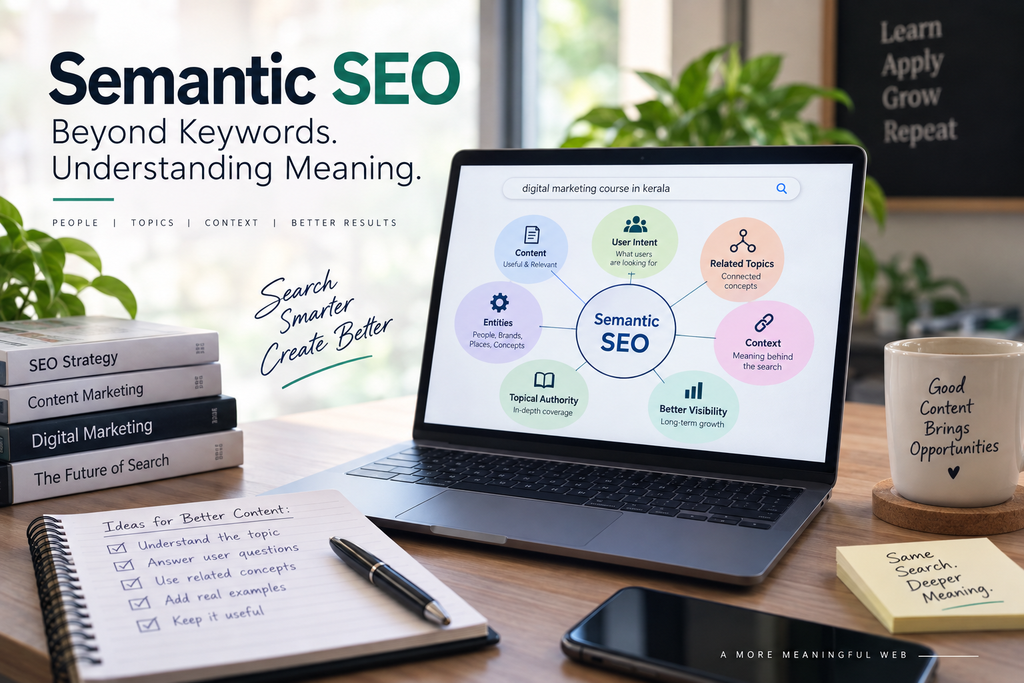
For many years, SEO was strongly associated with keywords.
Find a keyword.
Add it to the title.
Use it in the content.
Optimize the page.
Build backlinks.
But search has evolved.
Today, search engines are much better at understanding the meaning behind a search query, the relationship between different topics, and what a user is actually looking for.
This is where Semantic SEO becomes important.
Instead of focusing only on individual keywords, Semantic SEO focuses on meaning, context, search intent, related topics, entities, and the overall usefulness of content.
What Is Semantic SEO?
Semantic SEO is an approach to search engine optimization that focuses on helping search engines understand the meaning and context of your content, rather than simply matching exact keywords.
In simple terms:
Don’t optimize a page only for a keyword. Optimize it to completely answer the user’s need behind that keyword.
For example, imagine you want to create content around the keyword:
Digital Marketing
Simply repeating “digital marketing” throughout an article does not make the content comprehensive.
A user interested in digital marketing may also want to understand:
- SEO
- Google Ads
- Social Media Marketing
- Content Marketing
- Email Marketing
- Analytics
- Lead Generation
- Conversion
- Keyword Research
- Search Intent
These concepts are naturally connected to the broader topic of digital marketing.
Understanding these relationships is an important part of semantic optimization.
Semantic SEO vs Traditional Keyword Optimization
Traditional keyword optimization often starts with a question:
“What keyword should I rank for?”
Semantic SEO encourages us to ask another question:
“What does someone searching for this topic actually need to know?”
This shift is important.
Instead of creating a page that mentions a keyword many times, the goal is to create content that provides complete, useful and relevant information.
Keywords are still important.
But keywords are only one part of the bigger picture.
Why Is Search Intent Important in Semantic SEO?
One of the most important elements of Semantic SEO is search intent.
Consider the keyword:
SEO
What does the person searching for it actually want?
They might be looking for:
- An SEO definition
- An SEO course
- SEO services
- SEO tools
- SEO techniques
- An SEO career
- An SEO tutorial
The keyword itself does not tell the entire story.
Understanding the user’s intent helps you decide what type of content to create.
Common types of search intent
Informational intent
The user wants to learn something.
Navigational intent
The user is looking for a particular website, brand or page.
Commercial investigation
The user is comparing options before making a decision.
Transactional intent
The user is ready to take an action, such as purchasing or booking a service.
A strong SEO strategy considers intent before creating content.
Semantic SEO Is More Than Related Keywords
There is a common misunderstanding that Semantic SEO simply means adding related keywords to an article.
It is much broader than that.
Semantic SEO considers relationships between:
- Topics
- Concepts
- Entities
- Search queries
- User intent
- Content
- Websites
- Context
For example, if you are writing about Local SEO, related concepts might include Google Business Profile, local rankings, reviews, NAP consistency, citations, location pages and local search intent.
You don’t need to force these terms into the content.
They should appear naturally when they genuinely help the user understand the topic.
What Are Entities in SEO?
An entity is something that can be distinctly identified, such as a person, business, place, organization, product or concept.
For example, if your content is about digital marketing, relevant entities might include:
Google, Google Ads, Search Console, SEO, WordPress, Meta Ads, Analytics and other related concepts or platforms.
Understanding entities and their relationships can help create content with stronger topical context.
Instead of thinking only in terms of:
Keyword → Page
we can start thinking about:
Topic → Related concepts → Entities → User intent → Useful content
How to Implement Semantic SEO
You don’t need a complicated process to start.
Here are some practical steps.
1. Understand the Search Intent
Before writing, ask:
What is the user really trying to find?
Look at the search results, related questions and the type of pages Google is showing.
The search results themselves can provide useful clues about intent.
2. Build a Topic Map
Start with your main topic and identify the important subtopics around it.
For example:
Main topic:
SEO
Supporting topics:
- Keyword Research
- On-Page SEO
- Technical SEO
- Off-Page SEO
- Local SEO
- Link Building
- Search Console
- SEO Analytics
- Content Strategy
This creates a broader topic structure instead of treating every keyword as an isolated target.
3. Use Related Questions
Questions users commonly ask can help you understand what information they expect.
You can explore:
- People Also Ask
- Related searches
- Search suggestions
- Forums and communities
- Customer questions
- Sales and support conversations
These can help you discover content gaps and supporting topics.
4. Create Comprehensive Content
Don’t write an article simply because you found a keyword with search volume.
Ask whether your content actually solves the user’s problem.
A useful article should ideally answer the main question and also address important follow-up questions.
The goal is usefulness, not keyword density.
5. Build Meaningful Internal Links
Internal linking is another important part of building semantic relationships across your website.
For example, an SEO guide could link naturally to:
- Keyword Research
- Technical SEO
- Local SEO
- On-Page SEO
- Google Search Console
- SEO Analytics
This helps users discover related information and creates a clear content structure across your website.
A Simple Example
Let’s say you want to create a page targeting:
Digital Marketing Course in Kerala
Instead of writing the phrase repeatedly, think about what a potential student would actually want to know.
Your content could naturally cover:
- What digital marketing is
- SEO
- Google Ads
- Social media marketing
- Content creation
- Analytics
- Practical projects
- Tools students will learn
- Course structure
- Career opportunities
- Who the course is suitable for
- How practical training works
Now the page is not simply targeting a keyword.
It is answering the complete information need behind the search.
Semantic SEO and Topical Authority
Semantic SEO also connects closely with the idea of topical authority.
Imagine a website has one short article about SEO.
Another website has detailed, useful resources covering:
- SEO basics
- Keyword research
- Technical SEO
- Local SEO
- Content strategy
- Search intent
- Link building
- SEO analytics
- Semantic SEO
The second website demonstrates broader coverage of the subject.
This is why building a logical content ecosystem can be more valuable than publishing random articles around unrelated keywords.
Semantic SEO in the Age of AI Search
Search is also becoming increasingly conversational.
Users are asking longer and more specific questions, and AI-powered search experiences are changing how information is discovered and presented.
This makes context even more important.
A piece of content should not just contain the right words.
It should clearly communicate:
What is this about?
Who is it for?
What problem does it solve?
How are the concepts connected?
Why should the information be trusted?
This is one reason why creating genuinely useful, well-structured and experience-driven content matters more than simply producing large volumes of keyword-focused content.
What I Tell My SEO Students
While training students in SEO, I often notice that beginners focus heavily on keywords.
They ask:
“How many times should I use this keyword?”
My answer is usually:
“First understand what the user wants. Then create the best answer you can.”
SEO is not just about inserting keywords into a page.
It is about understanding people, search behaviour, content and context.
Once that foundation is clear, keyword optimization becomes much more meaningful.
Semantic SEO: The Bigger Picture
Semantic SEO does not mean that keywords are no longer important.
Keywords still help us understand what people search for.
But modern SEO requires us to look beyond individual words.
We need to understand:
Keywords + Search Intent + Topics + Entities + Context + Useful Content
That is where Semantic SEO becomes valuable.
The future of SEO is not about using more keywords.
It is about creating content that understands the question behind the query and provides a genuinely useful answer.
Final Thought
Don’t just ask:
“What keyword should I rank for?”
Start asking:
“What does my audience actually want to understand?”
That small change in thinking can completely change the way you approach SEO.
Don’t just optimize for keywords.
Optimize for meaning.
Frequently Asked Questions
What is Semantic SEO?
Semantic SEO is an approach to SEO that focuses on the meaning, context, relationships between concepts and search intent behind a query, rather than relying only on exact keyword matching.
Is Semantic SEO the same as using LSI keywords?
No. Semantic SEO is broader than adding related keywords. It involves understanding topics, entities, context, search intent and relationships between concepts.
Are keywords still important for Semantic SEO?
Yes. Keywords remain useful for understanding what users search for. Semantic SEO simply goes beyond keywords to understand the broader meaning and intent behind those searches.
How can I improve Semantic SEO on my website?
Start by understanding search intent, creating comprehensive topic-focused content, covering relevant subtopics, using meaningful internal links, organizing your website logically and demonstrating genuine expertise.
Does Semantic SEO help with AI search?
Semantic SEO can support clearer understanding of your content by search systems because it emphasizes context, relationships, entities and user intent. AI search is evolving rapidly, so strategies should continue to adapt as search behaviour and systems change.
Suggested SEO Settings
Primary Keyword: Semantic SEO
SEO Title: Semantic SEO: Meaning, Search Intent & Best Practices
Meta Description: Learn what Semantic SEO is, how search intent and context influence modern SEO, and practical ways to build more meaningful content.
URL Slug:/semantic-seo/
Suggested Related Keywords:
- Semantic SEO
- semantic search
- search intent
- topical authority
- entity SEO
- semantic keywords
- SEO content strategy
- content clusters
- modern SEO
- Semantic SEO strategy
Suggested Featured Image Text:
Semantic SEO
Beyond Keywords. Understanding Meaning.